Why the First Fix in Many HVAC Businesses Is Better Call Capture, Not More Leads
Before paying for more demand, protect the demand already trying to reach the business. Lead generation without strong inbound capture simply accelerates waste.
The Instinct to Buy More Leads
When revenue feels flat or growth stalls, the default response for most HVAC companies is to increase marketing spend. More Google Ads, more LSA budget, more lead aggregator subscriptions, more social media campaigns. The logic seems sound: more leads should mean more jobs, which should mean more revenue.
But this logic has a critical flaw. It assumes the business is capturing and converting the leads it already receives. For many HVAC companies, that assumption is wrong.
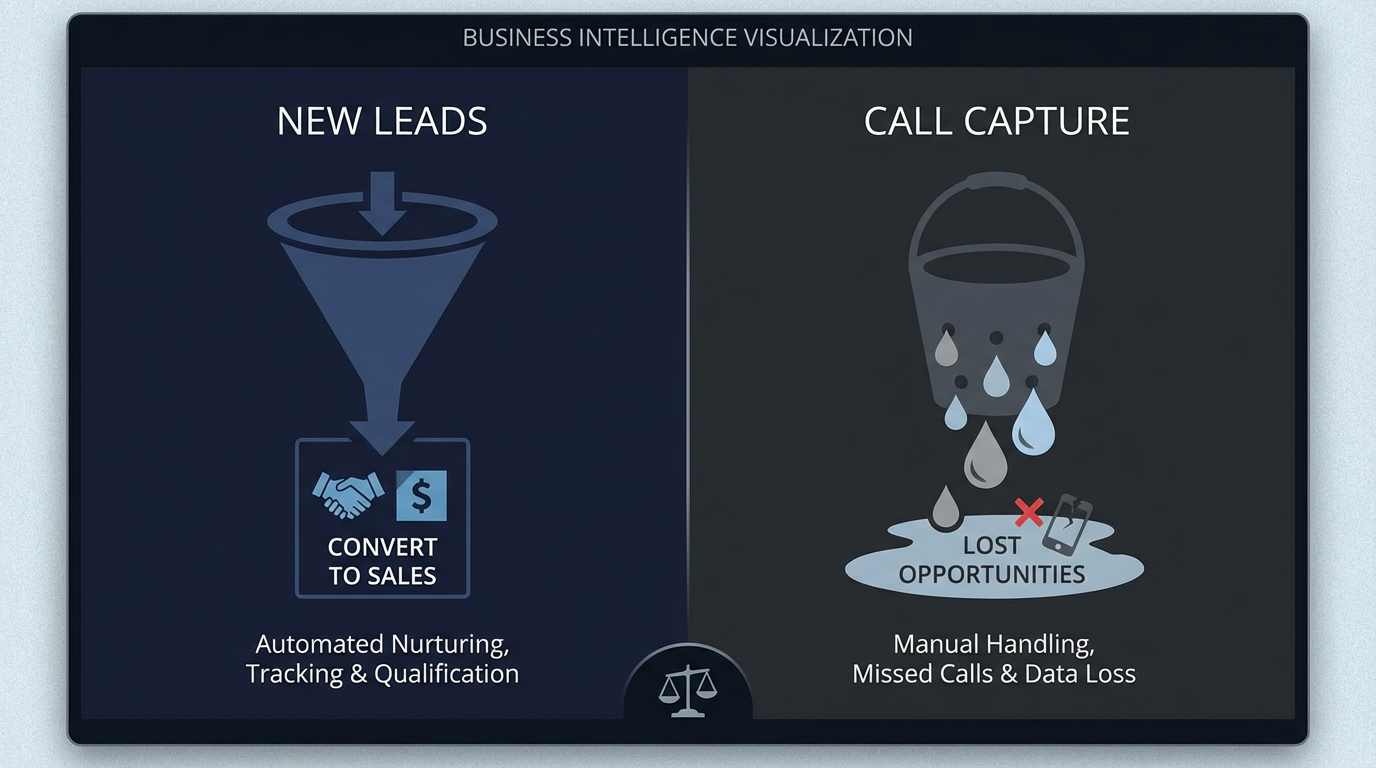
The Leaking Bucket Problem
Imagine a bucket with a hole in the bottom. You can pour more water into the bucket, and the level will rise temporarily — but the leak keeps draining it. The more water you pour, the more you lose through the hole.
In an HVAC business, inbound calls are the water. The hole is weak call capture. Every missed call, every call that goes to voicemail, every caller who hangs up after three rings, every after-hours inquiry that gets lost — these are leads the business already paid to generate that never reached the schedule.
Increasing ad spend while call capture is weak simply accelerates the leak. You pay more to generate more calls, and more of those calls go unanswered. The cost per booked job rises, the marketing ROI drops, and the owner wonders why growth spending is not producing growth.
The Economic Logic of Plugging the Easiest Leak First
Consider two scenarios for a five-truck HVAC company spending $5,000 per month on marketing:
Scenario A: Increase marketing spend by $2,000/month (40% increase). If current call capture is 70%, the additional spend generates roughly 28 more calls, 20 of which are answered, 7 of which book at a 35% rate. That is 7 additional jobs at $350 = $2,450 in new revenue. Cost: $2,000. Net gain: $450.
Scenario B: Fix call capture to improve from 70% to 90% (same marketing spend). On existing volume of approximately 200 monthly calls, 40 calls that were previously missed now get answered. At a 35% booking rate, that is 14 additional jobs at $350 = $4,900 in recovered revenue. Cost: significantly less than $2,000. Net gain: substantially higher.
In Scenario B, the business recovers more revenue without spending more on marketing. The ROI is better because the business is not generating new demand — it is capturing existing demand more effectively.
When Better Call Capture Is the Right First Fix
Not every HVAC business has a call capture problem. But if any of the following are true, it is likely a high-priority fix:
- More than 15% of inbound calls go unanswered during business hours
- After-hours calls go to voicemail with no live booking option
- The owner or a single office person is the primary call handler
- Call volume spikes during peak hours overwhelm available staff
- The business spends more than $3,000/month on lead generation
In these situations, fixing inbound capture before increasing ad spend is the economically rational first move.
The Inbound Booking Agent as a Fast Recovery Tool
For companies where missed calls are a meaningful leak, a simple inbound booking agent can serve as the fastest first fix. It ensures that every call is answered, every lead is captured, and every bookable job has a chance to reach the schedule — without hiring additional full-time office staff.
This is not a replacement for marketing. It is a prerequisite. Fix the capture first, then invest in generating more demand. The returns on marketing spend will be immediately and measurably better.
Take the Profit Leak Finder and see whether missed inbound revenue should be your first fix before you chase more leads.
Run the Diagnostic
Take the Profit Leak Finder and discover where your HVAC business may be leaking revenue and margin.
Start the Profit Leak Finder